Saturday, December 4, 2010

Early snow!

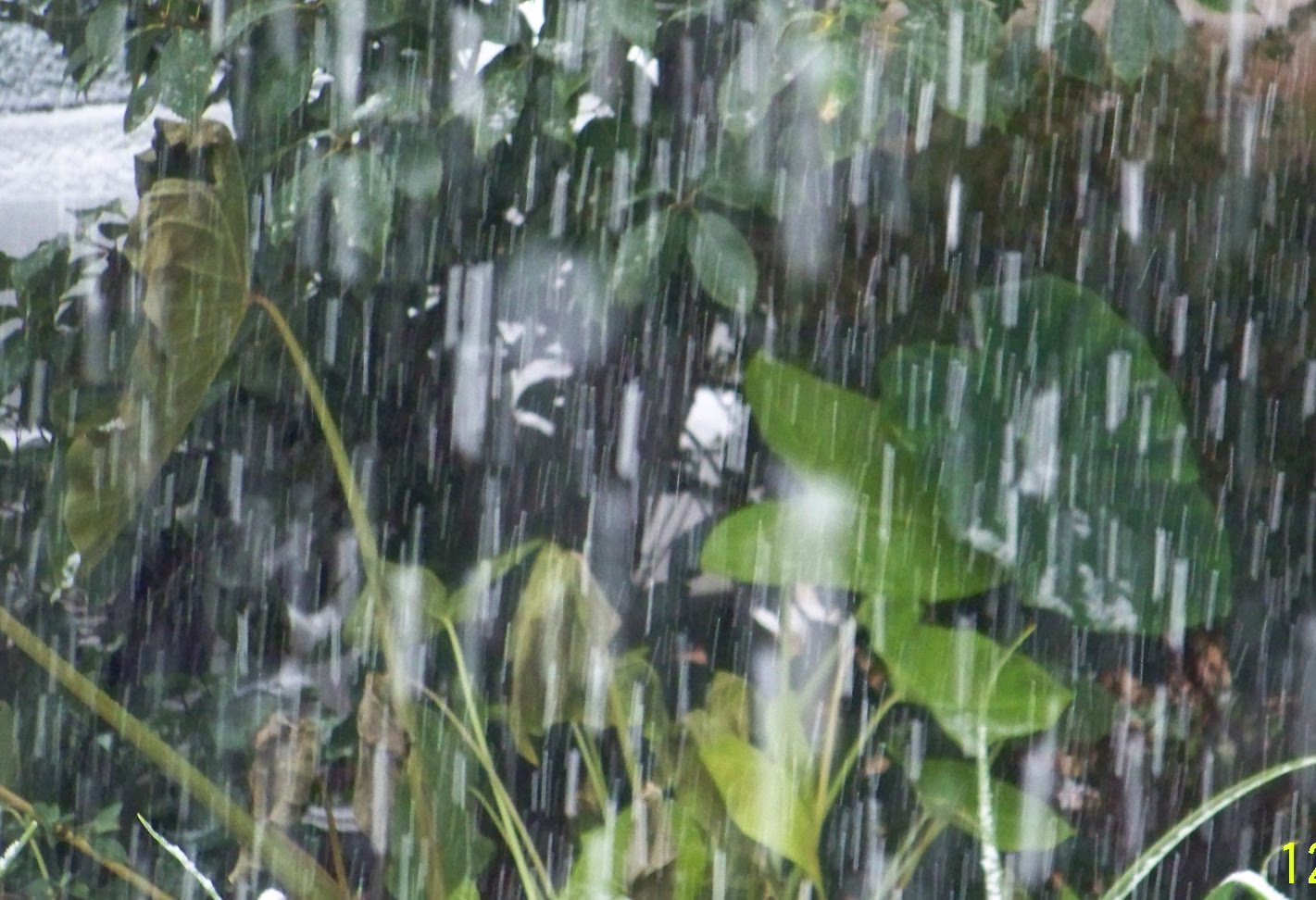
It is snowing hard as I type. I have been in Raleigh for nearly twenty-five years and I do not remember ever seeing snow accumulate this early. We've only had a few frosts, and no real cold weather. You can see in these photos that annuals such as geraniums and tender perennials like elephant ears have not yet died back.

Could be an interesting winter.


Wednesday, November 10, 2010

Ignoring it all


Yes, I'm afraid I have been ignoring both my blog and my garden.

This summer was so hot (a record number of above 90 degree days), that working the garden became more of a chore than a pleasure. Many of the new plants I put out in the spring could not stand the stress of the heat, even with adequate water. So, I've done very little in the last three months, other than basic maintenance.

We've had a few light frosts this past week, but only my very tender plants have begun to die back.

What I have been doing, instead, is quilting. It is normally my winter hobby, but I've spent a lot of time on quilting this fall.

I finally finished a Dresden Plate quilt that I started nearly twenty years ago! I found the pieced "plates" among fabric in an aunt's house, after she died. She was not a quilter, so I think my grandmother may have pieced them. (She died in 1958!) So, I appliqued them on blocks, quilted each block, then sewed them together. The construction is not very good, but I think it looks nice, over all. I had put this aside for a long time, as I honed my piecing and quilting skills. Just recently I pulled it out and finished it.

I've also pieced to quilt tops. One is small, so I can take it with me. The other will go on my quilting frame. These should keep me busy this winter.

Tuesday, August 24, 2010

Music


Music was everywhere in Russia. We had the great pleasure of seeing two ballet performances, and a folk music performance. Swan Lake was presented by the Russian National Ballet Company, in Moscow. It was an amazing performance. We saw Romeo and Juliet in St. Petersburg. It was a contemporary choreography. Quiet interesting with a very moving ending, but not really my cup of tea. But both the orchestra and dancers were excellent. In St. Petersburg we also saw a show called Feel Yourself Russian. I think this is designed for tourist. It was great fun, with a variety of traditional Russian music and dancing. Free vodka and champagne before the show and during intermission, too.

There was also music on the streets and at the various historic sites we visited. I've posted some of the more fun ones. The men with the horns were at Peterholf, which was the Summer Palace of the Tsars. (Where the Amber Room is located). I had never seen these before. They were amazing. When we first came upon them, they were playing Peter and the Wolf by Prokofiev. They then played several other things. It was amazing the range and tones they produced. I am sorry I did not think to video these men.

The man with the odd looking instrument was a street player in Old Arbat, the oldest part of Moscow. He made this instrument himself. Interestingly, he is pictured in the travel guide we used, Insight City Guide.

The video is a clip of folk musicians at the Museum of Wooden Architecture in Suzdal. This is an outdoor museum where a variety of historic log buildings have been moved to one locale.

More to come!

Sunday, August 22, 2010

Churches in Russia


We returned home thee days ago. Our Internet connection in St. Petersburg was slow, and our days were full, so I will add a few more posts about the trip now.
What I have learned about religion in Russia is fascinating. I certainly am no expert on the Russian Orthodox Church, but I have learned a bit.

Prior to the Revolution , churches were abundant and had many meanings for Russians. Merchants built churches as expressions of thanksgiving for their success. Many churches were built as tributes to fallen heroes. Churches served as community centers. In smaller communities, they were often used to safeguard merchants wares. Some towns, such as Suzdal, were religious centers. In the 19th Century there were 40 churches here, with only about 400 families! Often there were summer churches, which were large, lofty and unheated, and winter churches, which were much smaller, and had some heat source in them. The two white churches pictured above are in Suzdal.

After the revolution, religion was virtually banned in the Soviet Union. Churches, monasteries and convents were nationalized, and used as storage buildings, artists studios, concert halls, and other such activities. Convents and monasteries were often turned into prisons, for political prisoners. Many icons were removed to museums, others were sold to other countries to raise money for the Soviet government. There was some loosing of the restrictions during World War II, but they returned after the war.

With the collapse of the Soviet Union, there has been a significant return to religious practice. A great deal of money has been spent to restore churches throughout Russian. Many are restored as museums, to support the growing tourist industry. Every town we visited had churches as part of the planned tour. But there are a significant number of churches that hold services again.

The interiors of Russian Orthodox Churches are covered with frescoes, paintings and icons. Rarely is there a bare space. The wealthier churches are full of gilded or gold surfaces. There are no pews or chairs, as sitting during the service is not allowed. The onion dome represents a flame. As you see by the picture of the wooden church, not all churches have the domes.

I do not know what percentage of the Russian population claim religious affiliation, but clearly the churches are a very important part of their heritage. They are also beautiful buildings to visit.

Saturday, August 14, 2010

St. Petersburg


We arrived in St. Petersburg yesterday afternoon after a very fast train ride. It took only 4 1/2 hours, for a trip of more than 450 miles.

What a beautiful city! It reminds me a lot of Paris, which, of course, was Peter the Great's idea, when he founded the city in 1703. He based the development of the city on the great western European cities, particularly Paris and Venice. Much here is in honor of Peter the Great and Catherine the Great. This was the capital of Russia until Lenin moved it (back) to Moscow in 1918. During the first World War, the name was changed to Petrograd, because St. Petersburg was the German name. It was renamed Leningrad in 1924, after Lenin died. After the fall of the Soviet Union, city names throughout Russian were returned to their original name. So, back to St. Petersburg.

The city was built on the Neva River and has a wonderful collection of canals and bridges throughout the city. Our hotel is on the Embankment, just two blocks from the Hermitage. Boats run up and down the canals all day.

The city was devastated by the German siege, during WW II. What is amazing is that Stalin had the buildings rebuilt as they were after the War. I'm not exactly sure why, but the buildings were restored, rather than new buildings built, so St. Petersburg has few buildings representing the Stalin era. Stalin did see Moscow as the great Soviet city, and put his efforts (and money) there. To him, St. Petersburg was a tsarist city. He wasn't much interested in it.

Times have indeed changed. Prime Minister Putin is from St. Petersburg. He was the Russian President at the time of the 300 anniversary of the founding of the city, so a great deal of money was put into the restoration of the city.

The gold domed building is St. Isaac's Cathedral. We climbed up the 250+ steps to the colonnade, where there is a beautiful panoramic view of the city. Like many St. Petersburg churches, it is now a museum. The green building in front of it is the Hermitage. This was the Winter Palace of Catherine the Great. It was made a museum in 1917, and treasures from grand Russian estates were confiscated and placed here. We will visit it in a couple of days.

We also visited Yusupov Palace today. The theater pictured here is in the Palace. It was in the basement of this building where Rasputin was killed. This is one of the only Palaces in Russian that was preserved during the Soviet era. It was used as propaganda to support the socialist ideal, by showing citizens how wealthy the nobility was.

This is a very approachable city. We have done a great deal of walking around already. Most places we go the people speak a little English. There are tourist everywhere, from all over the world. They get more than 3 million tourist a year, which brings in 10% of the local economy.

Tomorrow we will take a hydrofoil down the river to Peterhof, which has some of the most magnificent gardens in the world.

Thursday, August 12, 2010

In Soviet Times


We have heard the term "in Soviet times" often from our tour guides. The first guide we had in Moscow said it with some obvious nostalgia. The second one with honesty and a bit of scorn. The guide who was with us the last two days, on the Golden Ring, seemed to have very mixed feelings. Clearly the transition to a capitalist society has not always been easy.

As part of the collectivization and nationalization of everything, private ownership of land and homes ended. Initially, people were housed in confiscated homes, churches and cultural buildings. Then large apartment buildings were built. According to our last guide, these were much sought after, because they had 'all the modern conveniences'. Her family lived (and she still lives) in Vladimir, about 120 miles from Moscow. The log homes had no running water or electricity. The new apartments had both. They also had heat from a central heating plant. In fact, everything is heated from central systems, through Moscow and the other cities.

With the end of "the Soviet time", people were give ownership of their flats or homes. Many then had them bilked away by shifty buyers. Most Russian still live in large apartment buildings. The one pictured here, with the colored panels, is in Vladimir. But they are everywhere in Moscow. Most were built in the 1950s and 60s under Khrushchev, who promised to solve the housing problems of the nation. Today they are crumbling, but still provide most of the housing for folks. Here are various pictures of houses, and apartments. The pipes are steam heating pipes. You see them everywhere. The bottom picture is the main government building in Vladimir. They do not seem to care about restoring the crumbling hammer and sickle.

Tuesday, August 10, 2010

Cars and more cars


Cars are everywhere in Moscow. Not surprising for a city of about 11 million, right? Except when you realize the history of cars here. According to our guide, during the Soviet era very few people had cars. To buy one, you had to be put on a waiting list, and it often took up to five years for you to buy a car. The only cars available were Russian made, which were very undependable. The green car above is an older Russian model, but in amazing condition.

All this changed only about 6 or 8 years ago. It was then that Russians began buying cars. And boy do they! And they do not buy Russian made. We see lots of Fords and Chevys. We see far more Mercedes, BMWs, Saabs, Volvos, Toyotas, Hondas. Some Cadaliacs and Hyundas as well. The Russian made cars are small and look battered.

Since cars really are new for the city, parking accommodations do not exist. No parking lots, no parking garages. So, people just park where they can. On the street and more often, on the sidewalk. The main streets are wide, because Stalin wanted lots of impressive streets for parades. Traffic is chaotic.

There are few taxi cabs. This is the only major city I have been in where you cannot hail a cab. You have to call for one. There are buses and cable cars, which just run on the major streets. But the metro is apparently excellent.